
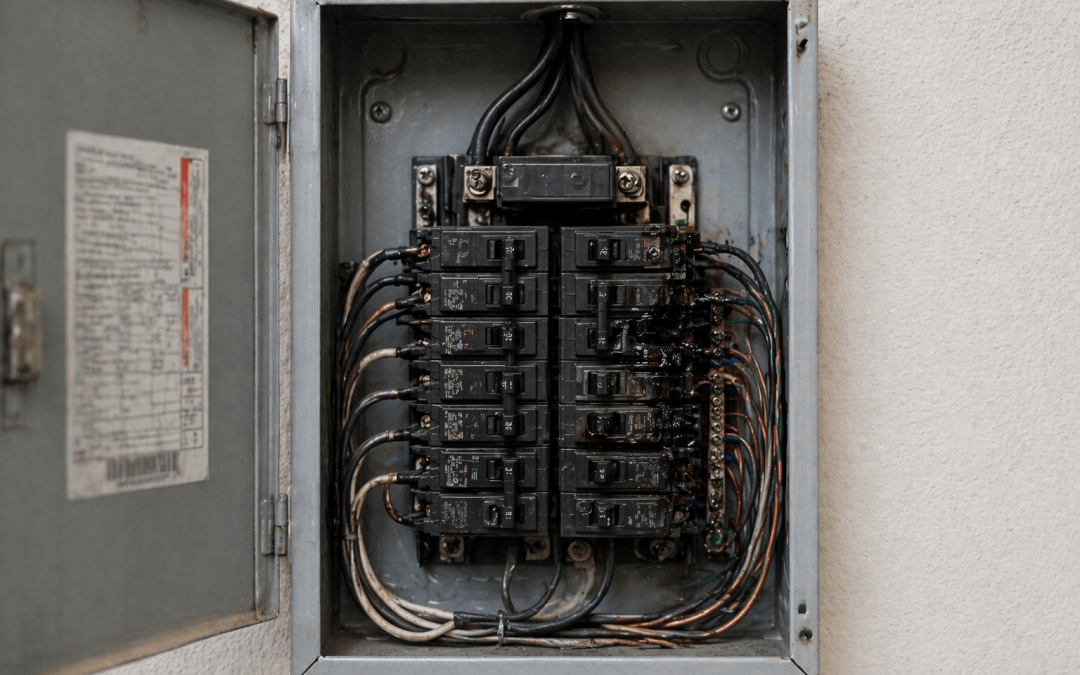
That’s what makes Zinsco panels different. The risk isn’t always obvious. It builds over time, often unnoticed, until a failure happens under load.
What Is a Zinsco Panel?
Zinsco panels were installed in homes primarily between the 1960s and 1970s. In some cases, they were later rebranded under Sylvania-Zinsco, but the underlying design remained largely the same.
Like other legacy systems, many of these panels are still in use today. And like Federal Pacific panels, they’ve become a recurring concern during home inspections and insurance reviews.
If that sounds familiar, it’s because the industry has already seen similar issues with other outdated systems. We broke that down in detail in our guide to Federal Pacific (FPE) Stab-Lok panels and their fire risk.
The Core Problem: Connection Failure and Heat
The main issue with Zinsco panels isn’t just the breakers—it’s how those breakers connect to the panel itself. Over time, the metal connection between the breaker and the bus bar can degrade. In some cases, corrosion or heat buildup causes the breaker to fuse to the bus bar instead of maintaining a clean electrical connection.
That creates a dangerous condition:
- Electricity continues flowing through a compromised connection
- Resistance builds at the contact point
- Heat increases gradually over time
- The panel begins to deteriorate internally
From the outside, everything can still look normal.
Breakers That Don’t Fully Disconnect Power
In some Zinsco panels, breakers may appear to trip but don’t fully interrupt the flow of electricity. That’s where the risk starts to compound. This can show up in subtle ways—circuits behaving inconsistently, power returning unexpectedly, or outlets acting unpredictably. If you’ve experienced that, it’s worth understanding what it means when one outlet stops working, especially in older homes.
In other cases, the first sign is repeated breaker activity. That’s often dismissed as a nuisance issue, but it can point to something deeper. We covered those patterns here: why circuit breakers keep tripping in Florida homes. In a properly functioning system, a breaker trip is a protective response. In a compromised system, it may not be enough.
How This Turns Into a Fire Risk
Electrical systems fail in predictable ways. When connections degrade and heat builds, materials begin to break down.
In a Zinsco panel, that can mean:
- Overheating at breaker connection points
- Melting insulation on nearby wiring
- Arcing between compromised contacts
- Heat transfer into surrounding materials
The National Fire Protection Association continues to identify electrical failure as a leading cause of residential fires. A panel that allows heat to build unchecked increases that exposure significantly.
Why Insurance Companies Flag Zinsco Panels
Insurance companies don’t evaluate individual panels—they evaluate patterns across thousands of homes. Zinsco panels show up often enough in inspections and claims data that many insurers treat them as a known risk. That can lead to:
- Policy denials
- Conditional approvals
- Required upgrades within a set timeframe
This is part of a broader trend. As we outlined in our guide to why insurance companies reject certain electrical panels in Florida, carriers are tightening requirements around older electrical systems. The Insurance Information Institute also notes that outdated electrical systems can impact a home’s insurability.
Should You Replace a Zinsco Panel?
In most cases, yes.
Because the issue is tied to the design of the panel and the condition of the connections, replacing breakers does not resolve the underlying problem. The long-term solution is a full panel replacement. That means installing a modern system designed to safely handle today’s electrical loads and shut down properly when needed. If you’re considering your options, you can learn more about the process on our electrical panel upgrade page.
Why This Matters in Florida
Florida adds another layer to the Zinsco conversation.
High Electrical Demand
Air conditioning, pool systems, and modern appliances place constant demand on electrical panels. Older systems are often operating near or beyond what they were originally designed for.
Storm and Surge Exposure
Lightning strikes and grid instability introduce repeated electrical stress. Many upgraded systems today include whole-home surge protection to help manage that risk.
Tighter Insurance Standards
Florida insurers are already working within a constrained market. That means less tolerance for equipment with known performance concerns.
The Bottom Line
Zinsco panels don’t usually announce themselves as a problem. They continue working—until the internal connections begin to fail in ways you can’t see. That’s what makes them risky. Not sudden failure, but gradual degradation under load.
For homeowners, the decision is similar to other legacy panel systems. Keep it in place and accept the uncertainty, or replace it with a modern panel designed to perform reliably under stress. In many cases, especially in Florida, that decision becomes less optional once insurance companies get involved.
Local Help If You’re Dealing With a Zinsco Panel
Zinsco panels tend to fly under the radar until something starts to feel off—an outlet stops working, a breaker behaves inconsistently, or an inspection raises questions. By that point, most homeowners are just looking for a clear answer on what they’re dealing with and what to do next.
Service Fanatics works with homeowners across Southwest Florida to evaluate older electrical panels, identify underlying issues, and handle replacements when they make sense. Whether you’re dealing with an insurance requirement or just want to understand the condition of your system, our licensed electricians can walk you through it in a straightforward way.
We provide electrical inspections, repairs, and full panel upgrades throughout Naples, Marco Island, Bonita Springs, Cape Coral, Fort Myers, Estero, Punta Gorda, Port Charlotte, and Babcock Ranch.
If you want to get clarity on your panel or take the next step toward an upgrade, you can start here:
