
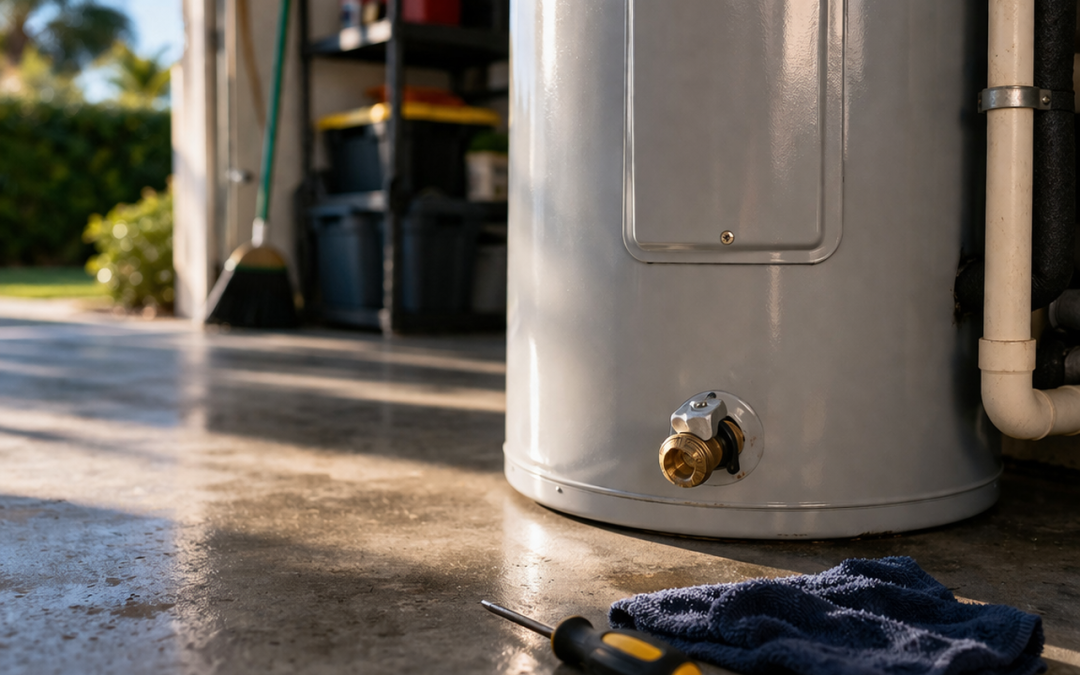
A repair quote can feel like the cheaper decision. But in Southwest Florida homes, hard water often changes the math.
What looks like a quick fix on paper can become the first payment on a replacement you’ll still need soon when sediment, mineral scale, and corrosion are already working against the tank.
For homeowners in Naples, Fort Myers, Cape Coral, Bonita Springs, Estero, Marco Island, Babcock Ranch, Port Charlotte, and Punta Gorda, the real question isn’t simply whether a water heater can be repaired—it’s whether the repair still makes financial sense in Florida conditions.
This guide breaks down the exact decision framework we use to help homeowners decide when to repair, when to replace, and when upgrading may save money long-term.
The 5 Factors That Decide Repair vs Replace
Before approving a repair, these are the five variables that matter most.
1) Age of the Tank
If the unit is under 6 years old, repairs like thermostats, heating elements, or valves often make sense.
Once the tank reaches 8–10 years in Florida hard water, replacement usually becomes the smarter long-term move.
The U.S. Department of Energy notes that conventional tank water heaters commonly last 10–15 years under ideal conditions, but Florida hard-water sediment and garage heat often compress that lifespan significantly.
2) Sediment Buildup
Southwest Florida mineral-heavy water leaves calcium and scale at the bottom of the tank, which traps heat and accelerates wear. If the tank is already rumbling, popping, or losing recovery speed, the repair may only solve the symptom—not the internal damage.
3) Corrosion
Visible rust around the bottom seam, fittings, or relief valve is a major warning sign. Once corrosion begins inside the shell, future leaks become much more likely.
4) Prior Repairs
If the heater has already needed multiple service calls, a new repair often means stacking costs onto a system already near failure.
5) Water Quality
If your home already struggles with the issues covered in our hard water plumbing guide for Southwest Florida, that should heavily influence the decision.
When Repair Still Makes Sense
There are still many situations where repair is the right answer.
- failed thermostat
- burned-out heating element
- faulty reset switch
- T&P valve issue
- drain valve replacement
- minor flex-line leak
- sediment flush on a younger tank
These repairs are especially reasonable when the tank is newer and the steel shell itself remains in good condition.
When Replacement Is the Smarter Move
This is where Florida homes differ from generic national advice.
Replacement is usually the better financial decision when:
- the unit is 8–10+ years old
- the bottom seam shows rust
- sediment noise is severe
- hot water recovery is slowing
- there have been repeat repairs
- energy bills are rising
- the tank sits in a humid garage
National home-maintenance experts at Better Homes & Gardens also list age, rust, repeat repairs, and declining hot-water performance among the clearest signals that replacement is financially smarter than another repair.
If you’re already seeing active moisture, this pairs directly with our guide on water heaters leaking from the bottom, which is one of the clearest replace-now signals.
The Florida Hard Water Math
This is the section most homeowners never get from national DIY blogs.
Hard water doesn’t just shorten lifespan—it changes the economics of repair.
The EPA’s WaterSense program strongly supports regular water system maintenance in mineral-heavy environments, since scale buildup directly reduces appliance efficiency and increases long-term operating costs.
As sediment accumulates, the tank needs more energy to heat the same amount of water. That means:
- higher electric or gas bills
- slower recovery
- more stress on elements and thermostats
- repeat service calls
- faster bottom corrosion
This is why a repair quote that feels reasonable today can become less attractive once you account for ongoing efficiency loss, especially in homes where sediment flushing has been delayed. Southern Living’s maintenance experts also emphasize that regular tank flushing plays a major role in extending heater lifespan in hard-water regions.
That’s why in Naples, Fort Myers, Cape Coral, and Bonita Springs, replacement often becomes the better 12–24 month financial decision.
Better Long-Term Upgrade Paths
If replacement is the smarter move, this is the best time to think strategically instead of simply replacing like-for-like.
Many Florida homeowners use this moment to evaluate:
- larger tank sizes
- faster recovery units
- tankless upgrades
- garage-safe leak pans
- whole-home water softeners
If efficiency and long-term utility savings are part of the decision, the DOE’s tankless water heater guidance is a strong reference point.
If you’re comparing upgrade options, our guide to tank vs tankless water heaters in Florida is the natural next step.
The Editorial Verdict
If your water heater is relatively new and the issue is isolated to a valve, thermostat, or heating element, repair is usually the right move.
But if the tank is older, heavily scaled, or already showing corrosion, Florida hard water changes the long-term math fast.
In many SWFL homes, the cheapest decision today is not always the least expensive decision over the next year.
That’s why the best question isn’t “Can it be repaired?”
It’s “Will this repair still make sense six months from now in Florida water conditions?”
